I took the same basic T-shirt and made it three ways — virgin cotton, recycled cotton and recycled polyester (rPET) — from field to incinerator, including its 50 washes. All three are sold as "the sustainable option". Recycling doesn't save the climate; it saves land, water and pesticides. This case takes it all the way to an EPD and a Digital Product Passport.
kg CO₂ eq per T-shirt, cradle-to-grave with 50 washes (line-dried). Same T-shirt, three fibres.
"Recycled" has a sustainable aura. The numbers say it depends on what you look at: in carbon almost nothing changes; in land and pesticides it changes everything. And no single figure, on its own, protects you from greenwashing.
Recycling cotton cuts carbon by 4%. But it cuts land use by up to 79% and pesticides by 71%. The carbon lies in spinning, weaving, dyeing and washing, not in the cotton.
Recycled polyester comes out cleanest in all five categories. But the number is blind to microplastics and to the fossil CO₂ from incinerating it. A low footprint is not a guarantee.
If no footprint is enough on its own, you need a data passport. The DPP asks for ~50 fields per garment; the LCA fills one. The rest is tested, certified and traced.
The same T-shirt: virgin cotton, recycled cotton or recycled polyester. All three are "the sustainable one". Which weighs least, and what data do you prove it with when the passport asks?
Recycling moves one thing a lot (land, water, pesticides) and another barely at all (climate), and the "cleanest" result hides what the calculation can't see. Any textile brand or buyer has this decision at stake, and the ESPR is going to start asking for the data to back it up.
How it was doneA cradle-to-grave LCA including the use phase: from growing the fibre to end of life, through spinning, weaving, dyeing, making-up, Asia→EU transport and washing. The unit of comparison is having a clean T-shirt available for 50 washes.
It was modelled in OpenLCA with EF 3.1, aligned with the Apparel & Footwear PEFCR (the European textile footprint rule), using an ecoinvent-type public database (BAFU). Recycling is handled with a cut-off approach.
In construction, the declaration follows EN 15804. Not in textiles: a garment's "EPD" (DAP in Spanish) is, in practice, a PEF profile following the PEFCR. It's the format the Commission recommends for substantiating environmental claims, and the basis of the footprint block in the Digital Passport.
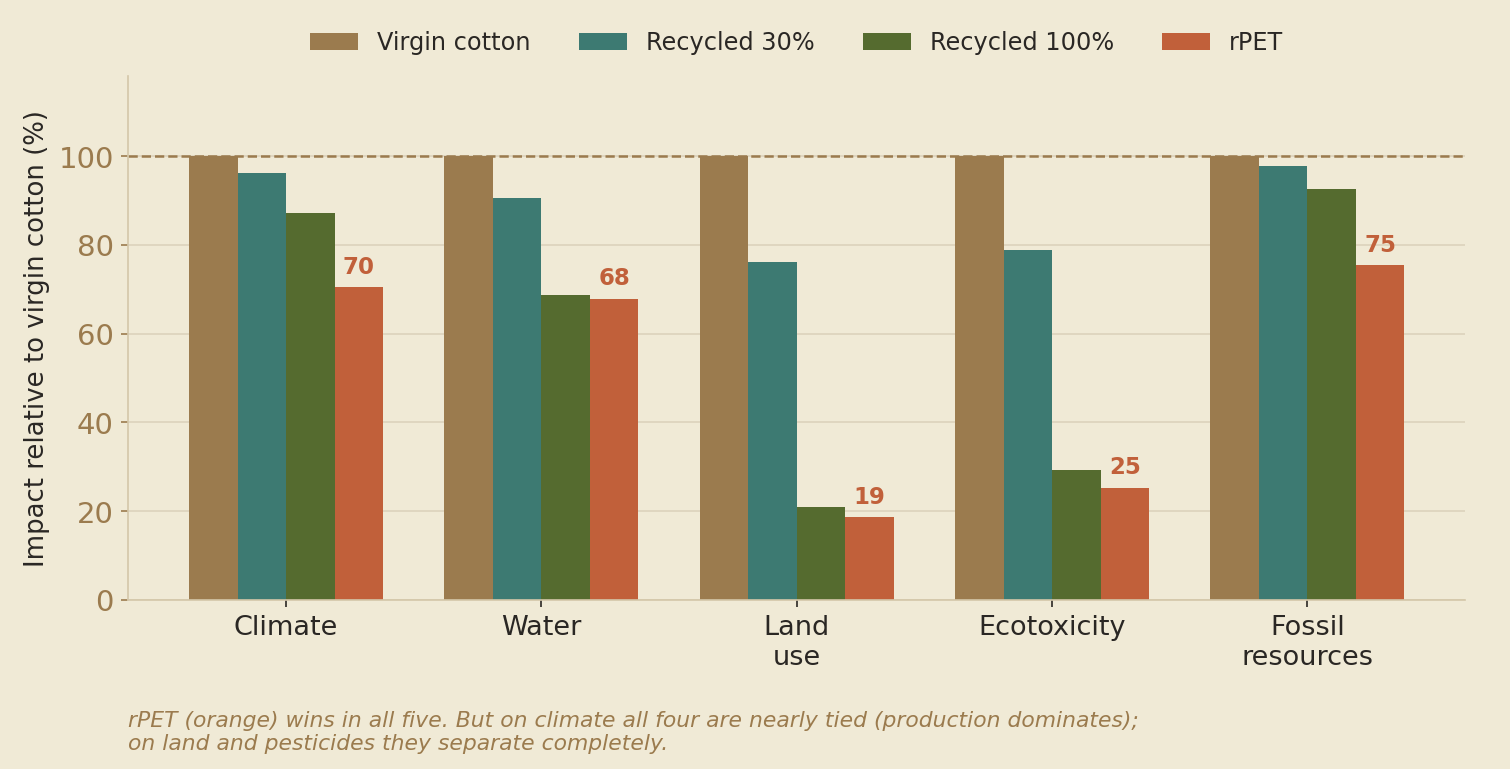
No fibre honestly wins on everything. On climate change all four are nearly tied — garment production dominates, not the fibre — but on land use, water and pesticides they separate completely. That's where recycling sweeps the board, because it skips cotton farming.
Switching from virgin to recycled cotton cuts the carbon footprint by 4%. Not even an ideal 100% recycled cotton goes beyond 13%. In a T-shirt, the carbon comes from spinning, weaving, dyeing and washing. And the small print: a shop-bought "recycled cotton" T-shirt is usually 30% recycled + 70% virgin, so it saves less than a third of what the label suggests.
Recycling doesn't touch the climate, but it skips farming. And there it sweeps the board: up to −79% in land use, −71% in ecotoxicity (the pesticides of conventional cotton) and −31% in water, for 100% recycled cotton versus virgin. The recycled T-shirt doesn't save the climate: it saves land, water and pesticides — the category the label never mentions.
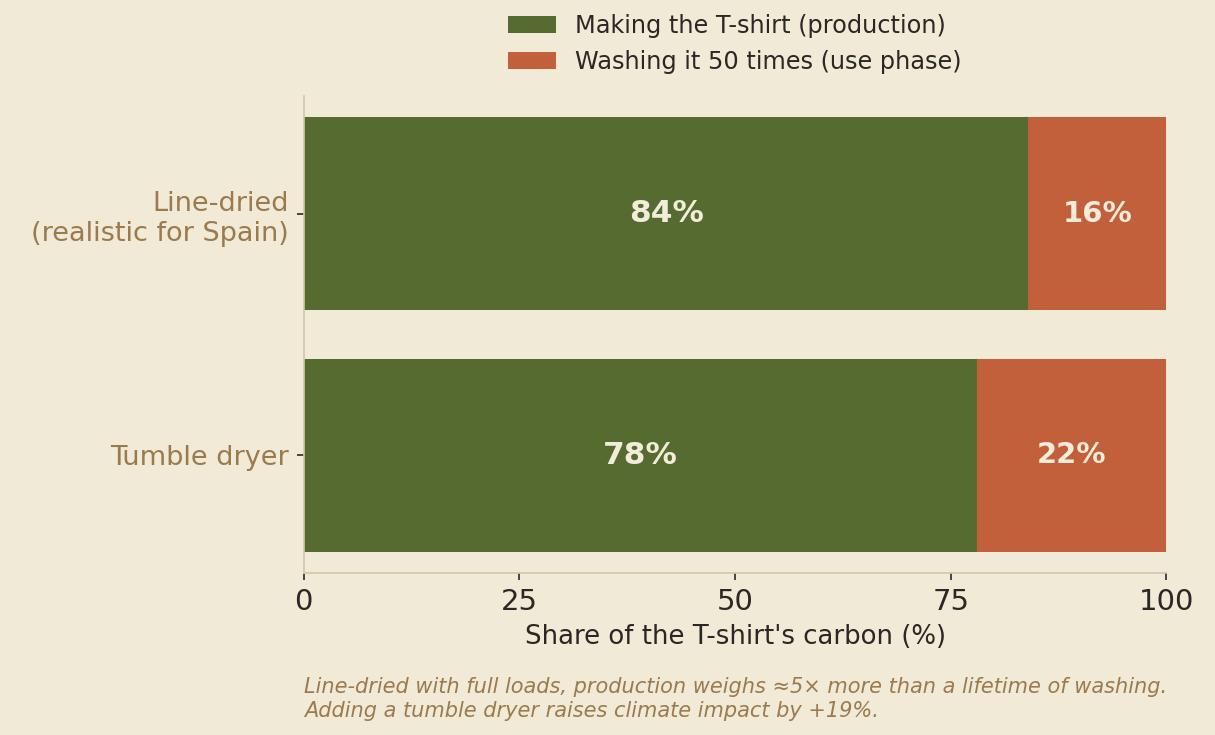
The headline doing the rounds in fashion — "the use phase dominates the footprint" — assumes a tumble dryer. With line-drying and full loads it flips: making the T-shirt weighs ~5 times more than washing it 50 times, because each load is shared across all the clothes (the garment gets ~4%) while the manufacturing is charged to it in full. The awkward corollary: changing how you dry matters more than changing the fibre — adding a tumble dryer raises climate impact by +19%, more than switching from virgin to 100% recycled cotton reduces it.
Recycled polyester comes out cleanest in all five categories. With standard datasets it is "the winner", and that's why "recycled" sounds sustainable. But the model is blind precisely to what matters most about polyester:
It sheds plastic fibres in every wash. There's no characterisation factor, so rPET doesn't "pay" for it in any category.
Incinerating it releases fossil CO₂, but the model reuses cotton's end of life (almost neutral). We give it a cleaner ending than it really has.
The post-consumer bottle comes in "burden-free". Another convention (the PEFCR's own CFF) would penalise it somewhat more.
It depends on bottles continuing to exist to be recycled, and competes for them with packaging recycling.
The lesson: the number says "rPET is the best"; the missing data says otherwise. A low footprint is not a guarantee of sustainability: it's a guarantee that you've measured what can be measured. That's exactly the gap the Digital Passport is meant to fill.
| Per T-shirt | Carbon footprint | vs. virgin | Land / pesticides / water |
|---|---|---|---|
| Virgin cotton | 4.66 kg | baseline | 100% / 100% / 100% |
| Recycled cotton 30% | 4.48 kg | −4% | partial reduction |
| Recycled cotton 100% | ≈4.1 kg | −13% | −79% / −71% / −31% |
| Recycled polyester (rPET) | 3.29 kg | −29% | wins in all five * |
* "Wins on the measured footprint" is not "is the best": the number is blind to microplastics and to the fossil CO₂ from incinerating rPET. See the polyester catch.
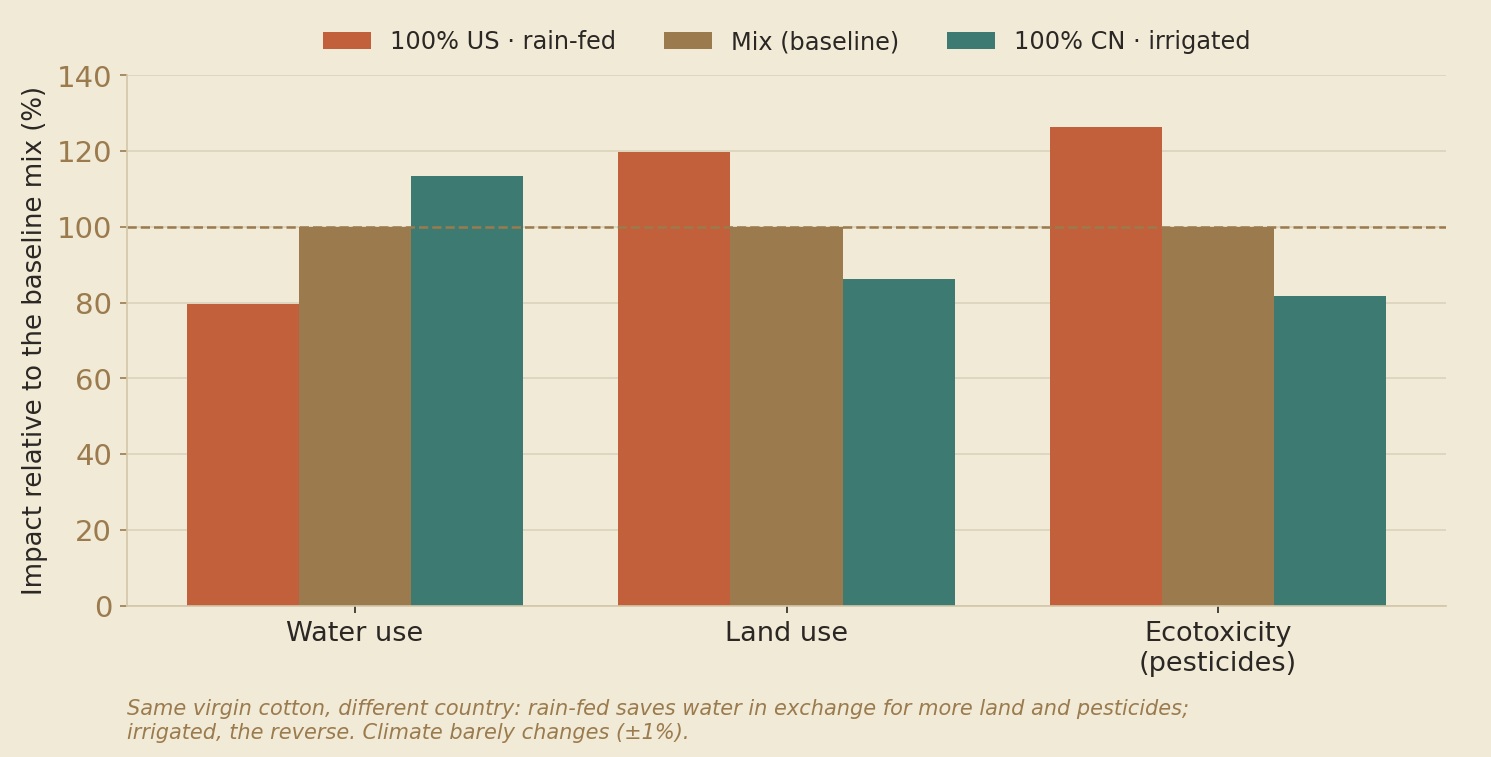
I modelled the same virgin cotton T-shirt with fibre 100% from the US (rain-fed) and 100% from China (irrigated). Changing country moves water by +42% (US→CN)… but it's a trade-off, not an improvement: rain-fed uses less water in exchange for +39% land and +54% pesticides; irrigated, the reverse. And the climate barely notices (±1%). There is no clean origin: changing country redistributes the impact across water, land and chemicals; it doesn't eliminate it.
Communicating only carbon hides the real win (land, water, pesticides) and the rPET catch. Honesty is multi-criteria.
Spinning, weaving, dyeing and the use phase dominate. That's where the carbon reductions are, not in switching fibre.
The Digital Passport asks for ~50 fields per garment. The LCA fills the footprint; the rest is tested, certified and traced.
Before putting "recycled" on the label, be clear about which category improves and which doesn't. And start building the passport data.
Ask for the multi-criteria profile, not a single figure. And the real % of recycled content, not the headline.
"Recycled T-shirt = low carbon" isn't supported by the numbers. Make the claim on the right category.
Durability, mono-material and real recyclability weigh more than the origin of the fibre.
The textile Digital Passport (JRC draft) asks for ~50 data points per garment. All the LCA modelling fills a single block: the environmental footprint. The rest comes from elsewhere.
| Passport block | Where the data comes from |
|---|---|
| Composition, % recycled, country-by-country traceability | Supply chain + chain-of-custody certificate |
| Chemicals (SVHC), durability, microplastics | Laboratory testing |
| Recyclability, care, repair | Product design |
| Environmental footprint (PEF) | The LCA |
That's why "what data do you fill it with?" isn't answered with a calculation but with a data system: traced suppliers, certificates and tests. That's the project the textile industry has to set up between now and ~2027.
During modelling, a single misplaced field — the reference unit of the rPET T-shirt — left its footprint 6.7 times too low and would have published a false headline ("rPET emits 4× less than cotton"). It was caught by quality control, not the software: the calculation threw no error. In an LCA for a declaration or a passport, traceability and verification aren't a formality: they're what separates a data point from a good-looking mistake.
An indicative profile using an ecoinvent-type public database (BAFU) and declared proxies (woven fabric standing in for knit, cotton dyeing for polyester, cotton end of life for rPET, no LCA factor for microplastics). It is not equivalent to a third-party verified PEF or to an official EPD/DPP: that's the next step, with primary data and a real client. A generic comparison with no brands.
Textiles are a priority group. It enables requirements on durability, recycled content, recyclability and the Digital Product Passport.
Delegated act expected ~2027, with ≥18 months' transition → actual application ~2028–2029. ~50 data points per garment.
The European textile footprint method. A garment's "EPD" is a PEF profile, not a construction EPD.
They tighten "eco / X% recycled" claims, standardise recycled content and require separate collection of textiles from 2025.
This case uses public data. Your product deserves its own: primary, verifiable, ready for your customer or the Digital Passport.