I took the same pine dining table and built it three ways — solid wood, particleboard and MDF — and used an LCA to calculate what each one costs, from felling to incinerator. All three are "wooden". The result is far from equal. Renewable is not the same as low-carbon.
kg fossil CO₂ eq to manufacture the table (production, A1–A3). Same table, three constructions.
The material we associate with "natural" — wood — doesn't guarantee a low footprint. What decides it is how much it's processed and how long it lasts.
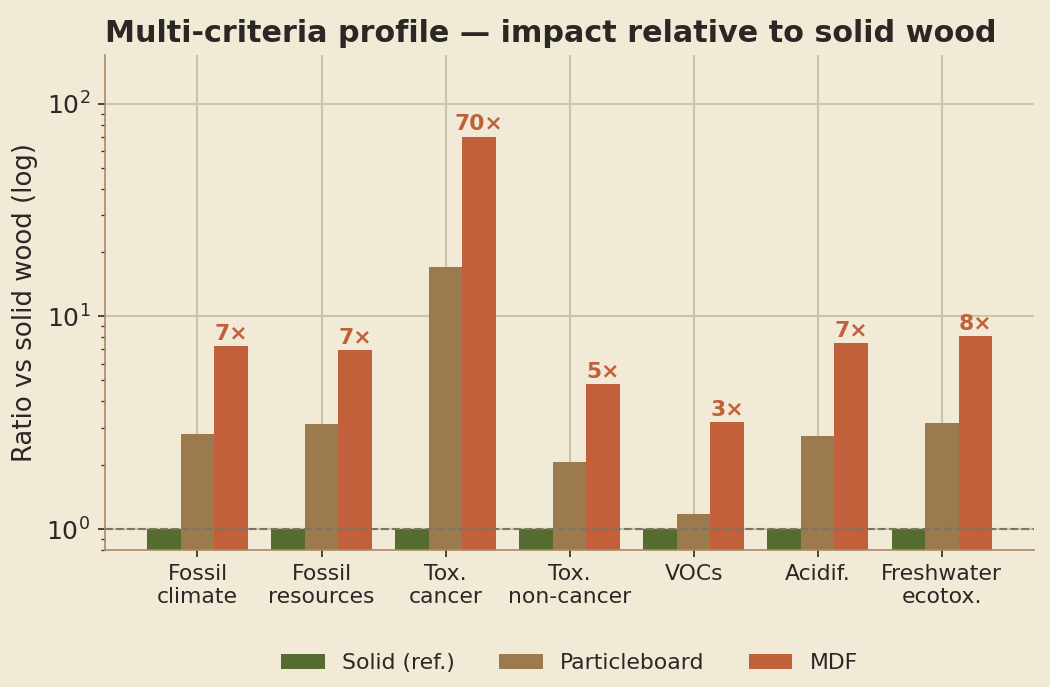
MDF, although it's wood, costs 7 times as much as solid wood. It's not the tree that decides, but the processing: shredding, resin and hot pressing.
In cancer toxicity, MDF reaches ≈70 times solid wood. The formaldehyde in the glues: a whole health category.
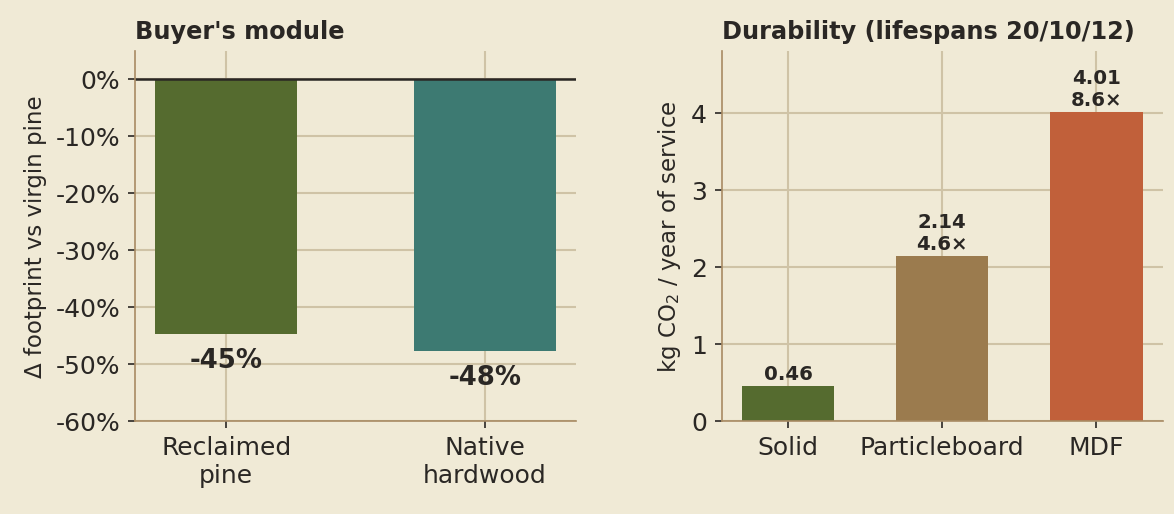
The most sustainable table isn't made of some magic wood: it's the one that already exists (reclaimed) or the one that will last 40 years.
The same table: solid wood, particleboard or MDF. All three are wood. Does it matter which one you buy?
Intuition says "wood = natural = sustainable". The numbers say it depends on how much you shred it and what glues you add. Any furniture manufacturer or buyer has this decision at stake, and the ESPR is going to start asking for data to back it up.
How it was doneA cradle-to-grave LCA: from raw material to end of life, including manufacturing, finishing and transport. The unit of comparison is not "a table" but a table that provides 15 years of service, so we compare like with like once durability comes into play.
It was modelled in OpenLCA with the EF 3.1 method using the public BAFU-2026 database. End of life was modelled as incineration with energy recovery, the usual route for furniture in the EU.
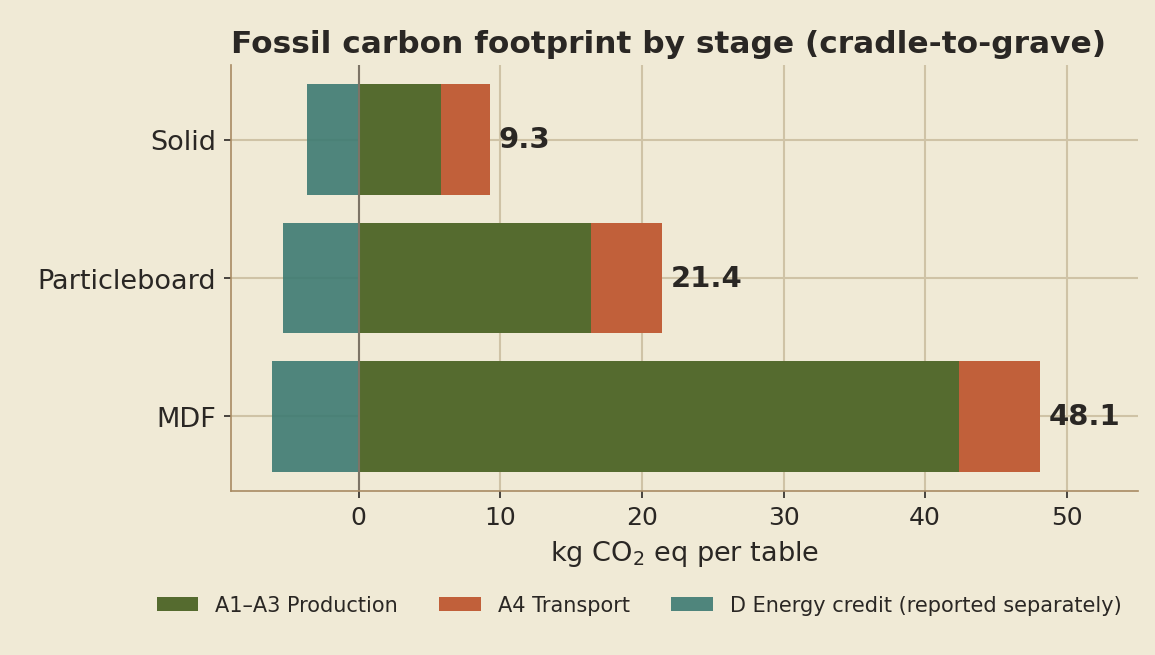
First finding: for all three tables, the impact barely sits in the factory; it lies in the degree of material processing. Solid wood is sawn and planed. Board is shredded, glued with resin and hot-pressed. That energy and that chemistry make all the difference: which is why "it's made of wood" says nothing about the footprint.
And a detail that only matters for clean wood: for the solid table, moving it 500 km accounts for 37% of its life cycle — almost as much as producing the wood itself. For MDF that same journey is barely 12%, because the material already carries 42 kg. "Do the kilometres eat up the natural advantage?" is a story about the low-footprint table: buying local is a real lever for solid wood and irrelevant for board.
Across the EF 3.1 categories, the order solid ≪ particleboard ≪ MDF holds in every one. And in human cancer toxicity, MDF reaches ≈70 times solid wood, due to the formaldehyde in the resins.
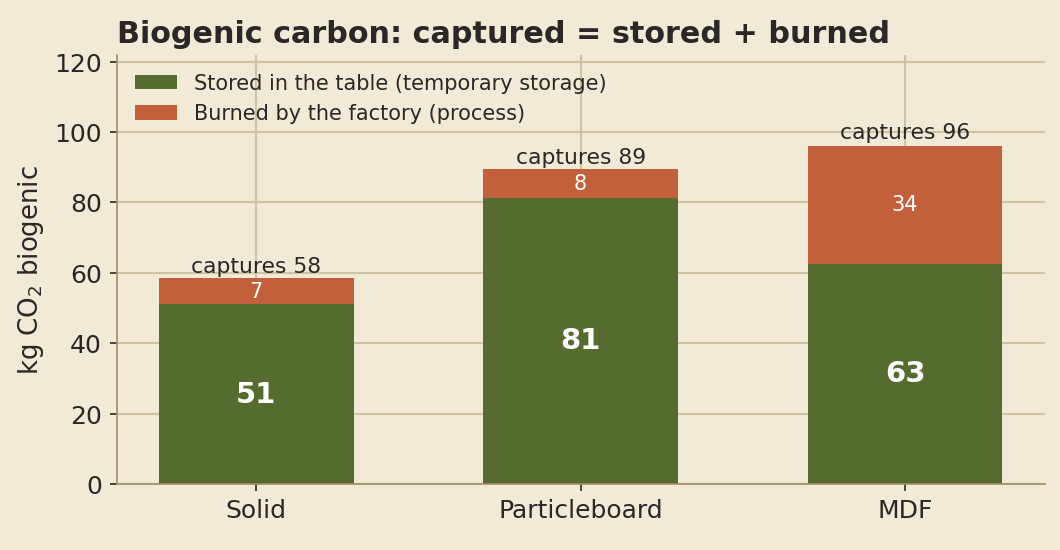
Wood captures CO₂ as it grows. Board stores more carbon than solid wood (81 and 63 kg versus 51) because of its greater mass. But it's a mirage: it's temporary, it's released on incineration, and MDF burns 35% of the carbon it captured just to be manufactured (solid wood, 12%). Processing eats up the renewable advantage.
The three tables don't last the same. Spreading the footprint over the years each one lasts (solid 20, melamine 10, MDF 12), the gap soars: per year of service, particleboard is 4.6× solid wood and MDF 8.6×. A piece of furniture that lasts half as long isn't half as cheap: it's twice the furniture. As for species, the honest answer is that it matters less than it seems: a reclaimed wood table emits 45% less.
| Construction | Production (A1–A3) | Life cycle (A–C) | Per year of service |
|---|---|---|---|
| Solid pine | 5.9 kg | 9.3 kg | 0.46 kg |
| Particleboard · melamine | 16.4 kg | 21.4 kg | 2.14 kg |
| Lacquered MDF | 42.4 kg | 48.1 kg | 4.01 kg |
Fossil carbon footprint per table. "Per year of service" = A–C life cycle ÷ service life (20/10/12 years). The solid ≪ particleboard ≪ MDF ranking doesn't flip in any scope.
We repeated the analysis with a method that translates everything into a single unit: euros. Not the price of the table, but the cost of preventing the environmental damage (Eco-costs 2025 method), for the production of the same models.
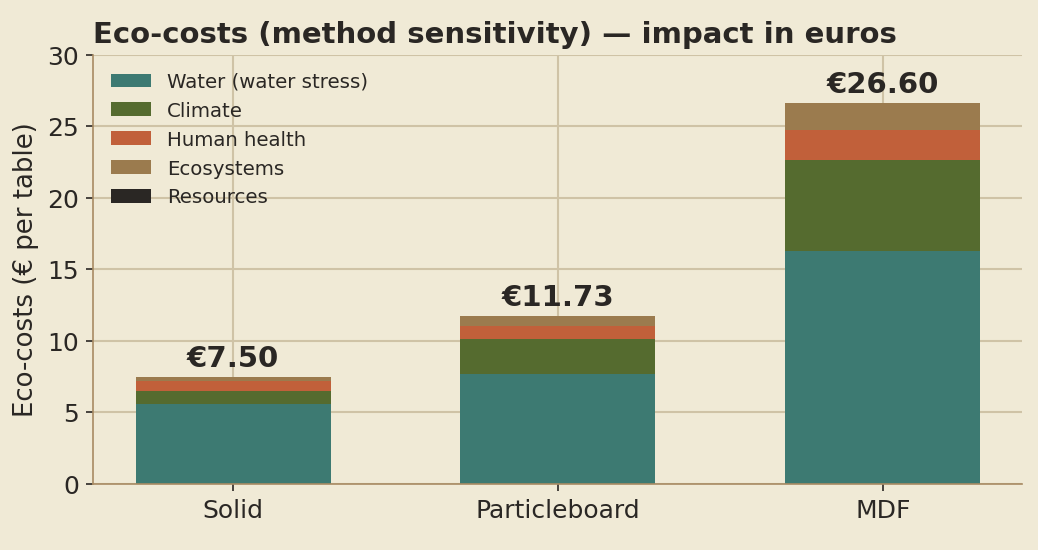
The ranking holds — solid wood wins in euros too — but the gap narrows (MDF goes from 7× in carbon to 3.5× in euros), because once the damage is monetised the main character becomes water, a common floor shared by all wooden tables.
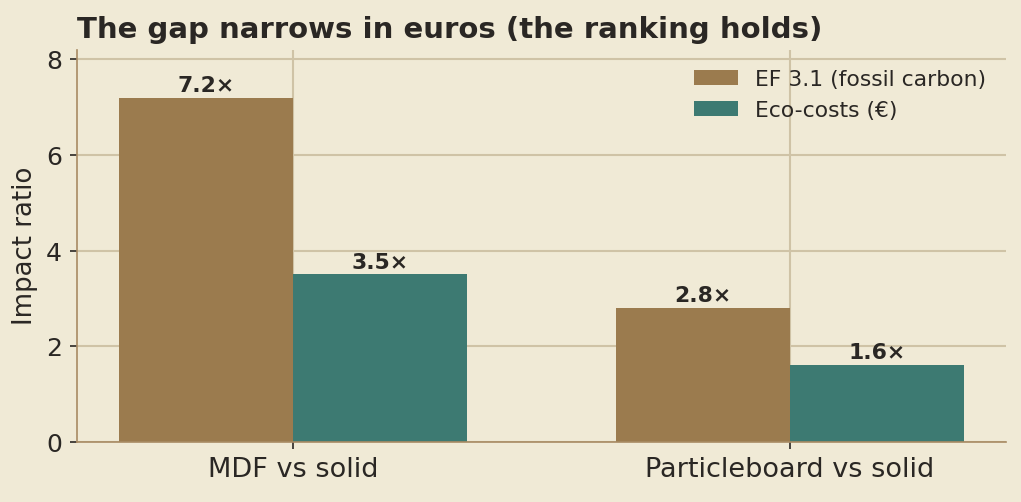
Water coming out on top is specific to the Eco-costs method, which heavily weights water scarcity. We checked it and it's real (sawing/board and hydroelectric power), but we report it "according to Eco-costs", not as a universal truth. The lesson: the ranking doesn't change with the method; the fine detail does. A good analysis shows this rather than hiding it.
Choosing solid wood over MDF is by far the biggest material lever.
What lasts spreads its footprint over more years. A piece that lasts twice as long is worth, in impact terms, half as much.
The most sustainable table is often the one that already exists. Reuse avoids almost all manufacturing.
Resins and lacquers load the health footprint. Low-VOC finishes and formaldehyde-free glues matter.
Your lever isn't "using wood", it's reducing processing and guaranteeing durability. The ESPR is going to ask you for data on both.
Ask for the footprint per year of service, not per piece, and prioritise repairability and reclaimed wood.
"It's wood, so it's sustainable" isn't supported by the numbers. Be careful claiming it.
Sustainability is decided at the design table: material, demountable joints and service life.
An indicative study using a public database (BAFU-2026) and some declared proxies: the hardwood is a generic dataset and the service lives (20/10/12 years) are an assumption grounded in the literature, not a measurement. It is not equivalent to an ISO 14040/44 certified LCA with a manufacturer's primary data: that's the next step, and it's done with a real client. A generic comparison with no brands.
Environmental product declarations already report biogenic carbon separately and modules A–D: the same logic this study follows.
Board emissions (EN 717) are already regulated precisely where board loses most here: resin toxicity.
Furniture is a priority group. Footprint by stage, processing, finishing and end of life — what this case measures — is exactly what that passport will require.
Requires proof that wood is deforestation-free. It strengthens the "local and certified" argument from the buyer's module.
This case uses public data. Your product deserves its own: primary, verifiable, ready for your customer or your tender.